
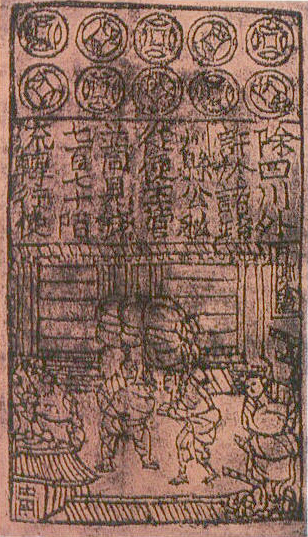
Imagine paying for a house with a cart full of iron coins. In early eleventh-century Sichuan that wasn't a joke. It was the problem that pushed China toward the world's first government-issued paper money.
A shortage of the wrong kind of metal
Sichuan merchants had a headache. Copper was scarce in the region, so local authorities issued iron coins instead. Iron was cheap, which meant a modest purchase of silk or tea could weigh as much as a sack of grain. A large deal needed a porter, or several.
Traders in Chengdu found a workaround. They left their heavy coins with a deposit shop and took away a paper receipt that could be redeemed later. The receipts were called jiaozi. They were easier to carry, easier to hide from robbers, and they passed from hand to hand as payment.
The state steps in
For a while private merchants issued these notes. Then some of the merchants failed to pay out, and disputes landed in court. Around 1024 the Song government took the system over and set up an official office to issue notes in Chengdu. Notes were released in fixed batches with a stated redemption period, and the state kept a reserve of coins to back them.
The printing itself was a feat. Woodblock printing, special paper, multiple inks and official seals made the notes hard to copy. Counterfeiting was still a problem, and the penalty for it could be severe.
Where it went wrong
Paper money works as long as people trust that they can swap it for something solid. When the Song court faced military pressure from the northern states, it printed more notes to pay for the army. The later huizi notes of the twelfth and thirteenth centuries lost value as the supply grew faster than the reserves. Prices rose, and people began to hoard coins and goods.
This is one of the earliest recorded cases of paper-money inflation. It wasn't the last, and the pattern will look familiar to anyone who has read about later episodes in Europe or Latin America.
The Mongols and Marco Polo
After the Mongols conquered China, the Yuan dynasty went further and made paper currency the main form of money across its territory. The Venetian traveller Marco Polo described the notes with plain astonishment, writing that the emperor turned bark into money and made everyone accept it. European readers found it hard to believe.
The idea did reach the West eventually, though slowly. Sweden issued the first European banknotes in the seventeenth century, several hundred years after the Song experiment.
Why it still matters
Song paper money shows what makes a currency work. It needs to be easy to carry, hard to fake, and backed by an institution people believe in. Lose the third and the first two don't help. The jiaozi began as a convenience for tea and silk merchants and turned into a lesson in monetary policy that governments are still relearning.



No comments:
Post a Comment